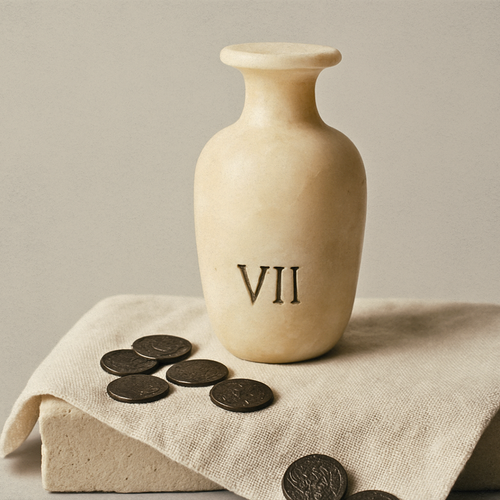
Sacra Renovatio: The Rite of Nightfall

From alabaster jars to clinical observation, the continuity of nightly devotion remains unbroken.
Sacra Renovatio: The Rite of Nightfall

The Roman Philosophy of Renewal

For the Romans, restoration was an ordered ritual: the final gesture of discipline at the edge of sleep. After the heat of the baths, skin was anointed with oils to preserve its balance and ease fatigue. Pliny the Elder records almond as a softener and rose as a tonic, while Galen blended oils with resins for their curative strength.

These practices reflected an unspoken principle: the body, left to its own rhythm, could repair what the day had unsettled. Night care provided the framework; physiology did the rest. Ritual provided the structure for nature to work.

Fig. 01
Sacra Renovatio: The Rite of Nightfall

The Oils of Antiquity

Among the most valued were almond and lavender. Almond lent suppleness; lavender cooled inflamed skin and scented linens. Frankincense, traded over long distances and reserved for temples and medicine, entered Rome as both perfume and remedy, its smoke rising in sanctuaries and unguents alike.

Explicit mentions of nut oils such as hazelnut are rare in Roman pharmacological texts, yet archaeological residues and cultivation records from Gaul and Cisalpine Italy confirm their place in domestic trade. Their lighter texture made them suitable for facial anointing, tempering heavier base oils in restorative blends.

Together, these materials formed a coherent vocabulary of care: few ingredients, clearly chosen and used consistently.

Fig. 02
Sacra Renovatio: The Rite of Nightfall

Modern Parallels

Contemporary analysis largely confirms their logic. Almond oil, rich in oleic acid and vitamin E, supports the barrier and reduces transepidermal water loss. Lavender, containing linalool and linalyl acetate, shows anti-inflammatory and calming effects. Frankincense yields boswellic acids that help quiet irritation, while hazelnut oil contributes gentle astringency that supports tone and elasticity.

The architecture of repair remains familiar: emollients reinforcing the lipid barrier, active compounds moderating visible reactivity, and a surface left flexible.

Essential Elements

Residues in unguentaria unearthed at Pompeii show traces of almond and resin oils, confirming their role in Roman bathing rituals. These vessels, often found near thermae, suggest that care was a shared practice as much as a private one.

Renewal, in this framework, was a matter of maintenance: the preservation of order through attentive repetition.

Fig. 03
Sacra Renovatio: The Rite of Nightfall

The Modern Heir: Evening Primrose Oil

The inclusion of Evening Primrose Oil marks a deliberate extension of this lineage. Unknown to the ancients yet aligned with their philosophy, its seeds yield one of the richest botanical sources of gamma-linolenic acid (GLA), an omega-6 fatty acid relevant to epidermal resilience. First documented by European botanists in the seventeenth century, it has since taken its place in dermatological repair for its role in restoring barrier lipids and moderating visible inflammation.

Where Rome relied on almond and resin to soothe, Evening Primrose pursues the same intent with finer molecular detail — a botanical descendant of ancient care, read through modern method. Its use in Sacra Renovatio turns night care into a continuation of study: a considered progression of what the Romans began, refined under laboratory light.

Closing Reflection

To anoint the skin with Sacra Renovatio is to bridge the Roman apothecary’s jar and the modern dropper. Each application is an act of calibration, a nightly ritual that honours an old conviction, that repair is most effective when the work of the formula and the work of the body synchronise at the same hour.

“It is the mind that shapes the body.” — Juvenal, Satires

References

Pliny the Elder, Naturalis Historia, Book XV, §22.

Mentions almond and rose oils in domestic and cosmetic use.

Galen, De Compositione Medicamentorum Secundum Locos.

Documents resin-oil mixtures as topical restoratives.

Pompeii Excavation Records, Museo Archeologico Nazionale di Napoli, Catalogue Nos. 4112–4119.

Analysis of unguentaria residues identifying almond and resin oils near the Stabian Baths.

Ziboh, V. A. (2004).

“The Role of Gamma-Linolenic Acid in Skin Health,”Prostaglandins, Leukotrienes & Essential Fatty Acids, 70(3), 199–207 — Describes GLA’s biochemical role in epidermal structure and recovery.

Fan, Y., et al. (2019).

“Topical Evening Primrose Oil for Atopic Dermatitis: A Systematic Review,”Journal of Dermatological Science, 94(2), 243–250 — Confirms GLA’s efficacy in skin barrier restoration and inflammation reduction.

Related Reading

Aurum (Gold) — Light, Safety, and Use

Aurum (Gold) — Light, Safety, and Use

September 2025
Hydration vs. Moisture — Hyaluronic Acid 101

Hydration vs. Moisture — Hyaluronic Acid 101

September 2025
Aurum Lustrum: The Alchemy of Light

Aurum Lustrum: The Alchemy of Light

August 2025

Originally published: September 2025 – Sapientarium Chronicle III

From the Press

The house magazine—features, letters, and conversations from inside the Temple.

Enter the Press